
Desist, de-escalate and dialogue to protect Nairobi National Park


The violent disruption of a public procession and arrest of nine environmentalists including a former Chief Justice on the 8 June elevated the proposed development in Nairobi National Park to international public attention. As the matter heads to court later this month, what is at stake, and what would a win–win outcome look like? This column was co-written with JustAct Executive Director Akshay Vishwanath.
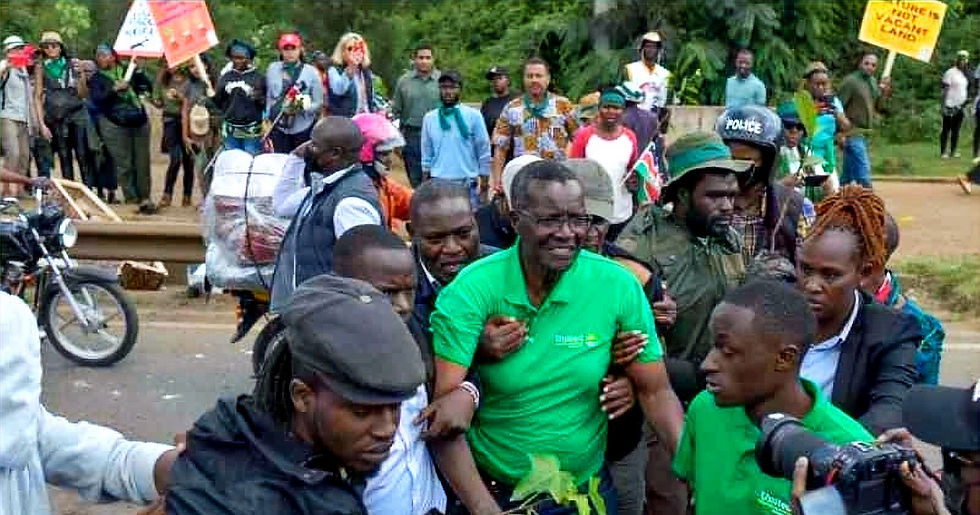
Convened by Friends of Nairobi National Park (FONNAP), JustAct, Green Belt Movement and Greenpeace Africa, a few hundred ethnically and generationally diverse environmentalists including grandparents and students, marched to present tree seedlings to the Kenya Wildlife Service. After initial negotiations over the police notice, the procession was cleared to proceed by a senior uniformed police commander after several calls to the “higher ups”.
Three-quarters along the 10-kilometre route, 6–8 armed plainclothes officers with their faces hidden by COVID-19 facemasks dispersed the peaceful march with teargas, beat and arrested nine participants while being filmed by the mass media. The nine were held at Lang’ata Police Station for eight hours, where no charges were filed, and they were released following representation by the Law Society of Kenya led personally by its President Charles Kanjama.
The heavy-handed crackdown completely backfired. The violence and the concerns being raised by the wildlife defenders dominated national and international headlines and eclipsed other major news including the President Ruto’s international engagements for the rest of the week. Unintentionally, the masked officers had amplified the environmentalists’ cause far beyond the initial march itself.
Opposition to opening the park to commercial infrastructural development for a refurbished orphanage/zoo and expansive parking for the Bomas International Conference Centre (BICC) has been simmering between the 31-year-old FONNAP and the Kenya Wildlife Services for months.
FONNAP contends defending the territorial integrity of Nairobi National Park is not only about protecting 500 endangered species of lions, rhinos, giraffes and birds and other animals. It is also safeguarding Nairobi’s right to a public park, clean air, clean water and a cool climate from short-term profit and long-term collapse. The Park has already lost 179 acres to the Standard Guage Railway, Southern Bypass and Internal Container Depot Road. The proposal to develop a further 89 acres for a 1,300-car park for BICC and a relocated animal orphanage would bring the total park loss to nearly 4 per cent in the past decade. There is no justification for surrendering prime wildlife habitat when viable alternative sites exist.
KWS argues the biodiversity risks are exaggerated. The 89 acres already being excavated near Galleria-Bomas along Langata road is largely vacant grassland and only 0.3 per cent of the current park. The current orphanage is dilapidated and KWS will continue to manage the Sh 4 billion investment to modernize the veterinary rescue services.
Independent scrutiny is undermined by the lack of consultation and agreement prior to the ongoing construction. Key documents including the Environmental Impact Assessment, maps, licenses, biodiversity surveys, plans, agreements and participation records remain inaccessible to stakeholders. Without these, policymakers, oversight bodies and the public cannot assess its legal compliance, the true impact on the park, or the claimed benefits of the BICC-linked development. Plans to encroach the public park should trigger deeper interest in the BICC public private partnership, how is the project structured? Who has commissioned the car park in the Nairobi National Park, and who will operate and benefit from the parking fees?
It is time for the Environment and Tourism Cabinet Secretary to de-escalate, hit pause, publish documents, host a public meeting, and allow independent experts to review the project. Failure to do this, risks converting East Africa’s oldest national wildlife sanctuary into a service zone for city infrastructure. The only boundary between a park that turns eighty in December and land capture is strong law, state compliance and public vigilance. Without these three, Kenya will lose eight decades of state protected ecological assets.
Once again, this generation must collectively rise to safeguard our national heritage and the ecosystem both our wildlife and people depend on.
This opinion was also published in the Saturday Standard, 13 June 2026.


Comments